




by Brian Shilhavy
Health Impact News
There continues to be a lot of conflicting opinions on Wall Street about the financial status of the United States as we draw near to the end of 2025 and look ahead to 2026.
The AI bubble and the huge investments in new data centers continue to dominate the financial news streams, with more analysts sounding the alarm while other analysts contradict them and state that the AI bubble is being over-hyped and is not really something to be too concerned about.
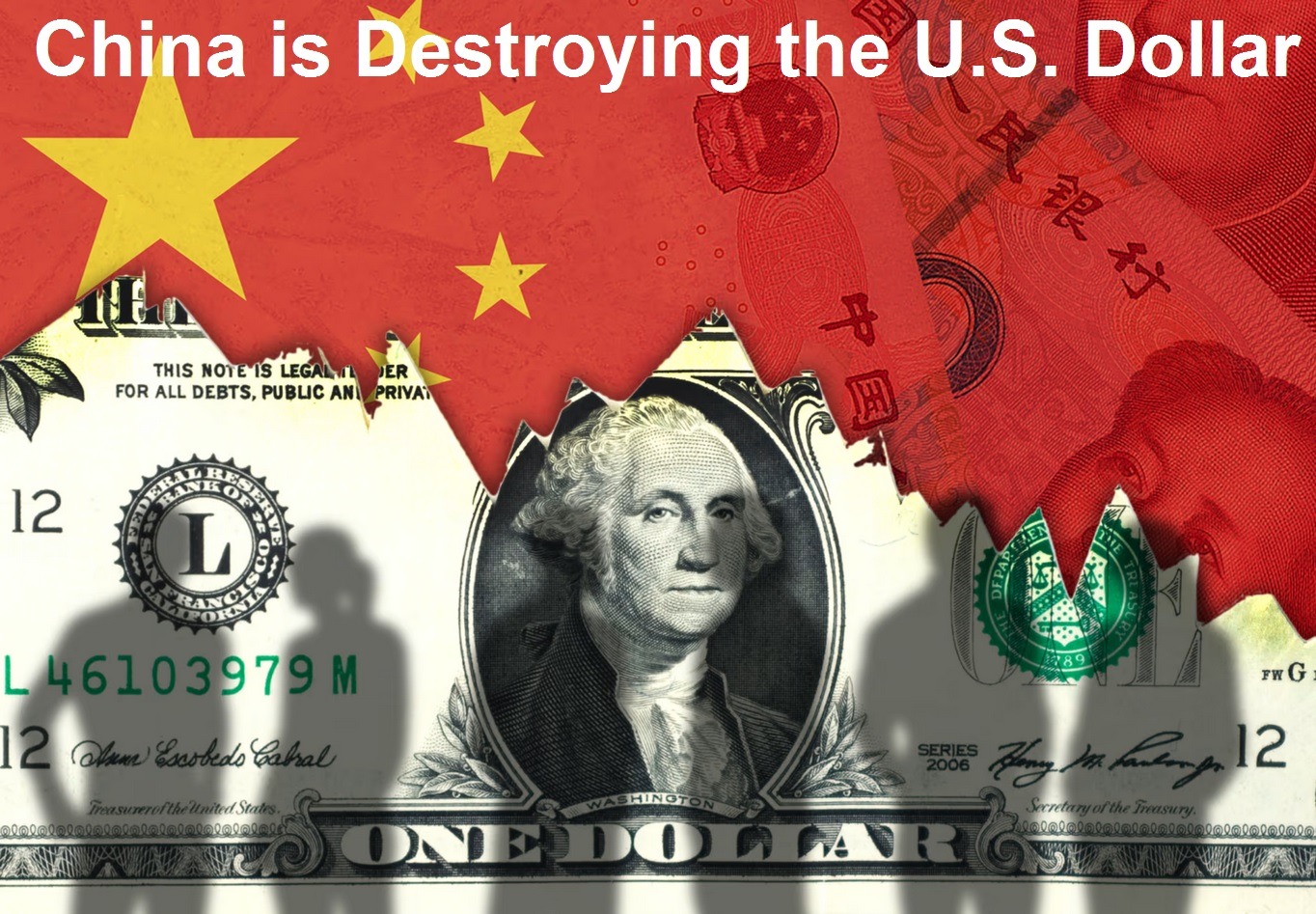
But there is one financial analyst who published an opinion piece today that was picked up by the Wall Street publication Market Watch that is sounding the alarm not just on the AI bubble, but a topic that he says is way under-reported and even suppressed in the U.S. financial news sector, which is that China is “quietly” destroying the U.S. dollar.
By “quietly” he means that it is not being widely reported in the U.S., and that therefore few investors (or Americans in general) are even aware that this is happening.
Here are some excerpts from Charlie Garcia’s shocking article published on Market Watch today.
China is quietly destroying the dollar — and that’ll cost you.
China controls the rare earths. China controls the cobalt. China, through its Belt and Road spending spree, now controls most of the mines in Africa that produce the stuff inside your phone, your car and your refrigerator.
And now, China has figured out how to price and settle all of it without using a single U.S. dollar — and nobody’s told you.
South African banking giant Standard Bank Group, Africa’s largest lender, has quietly integrated with China’s Cross-Border Interbank Payment System (CIPS).
In June, Standard Bank secured its CIPS license; in September the new rail went live, and by November Africa’s first direct yuan, or renminbi, channel was open — a seemingly dry banking milestone that in reality shifted a crucial line on the hidden map of global power.
The financial press buried it under Federal Reserve noise and earnings reports. Everyone kept scrolling. But the dollar’s monopoly is cracking.
It matters to you. Not because you trade cobalt futures. Because when the U.S. dollar loses its monopoly on pricing the world’s critical resources, your purchasing power shrinks.
That shows up at the grocery store, at the gas pump and in every aisle of every store. You just won’t know why.
Here’s what happened:
A payment that used to take three to five days now takes seven seconds. Costs dropped 98%. A cobalt shipment from Congo to Shanghai now settles in Chinese yuan, without touching New York, without anyone in Washington getting a vote. The dollar just got cut out of the transaction entirely.
This isn’t about banking plumbing. It’s about power. Who sets commodity prices. Who controls sanctions. Who gets to define “risk-free.”
For 50 years, that’s been the U.S.
Not anymore.
Here’s what happened while America was busy with Fed meetings.
Africa holds about 30% of the world’s critical minerals. Congo has most of the cobalt. South Africa has the platinum. The continent is loaded with copper, chromium, lithium and rare earths.
This is not optional stuff.
Cobalt goes in every EV battery. Rare earths go in every semiconductor. Platinum goes in hydrogen fuel cells.
If the 21st century runs on anything besides oil, it runs on African rocks.
China noticed.
Beijing has spent the past decade writing checks to Africa. Its Belt and Road initiative poured money into African mining; railways to the mines; ports to ship the ore, refineries to process it — and contracts that guarantee Chinese buyers get first dibs on the output.
By the first half of 2025, Chinese investment in African mining was up almost 400% from the year before. Mining now represents 20% of all Chinese projects in Africa, up from 8% five years ago. This isn’t foreign aid. This is vertical integration.
China bought the warehouse. Now they’re changing the currency on the cash register.
Standard Bank operates in 21 African countries. It handles trade finance across the continent.
When it plugs into CIPS, every mining company, commodity trader and central bank in its network now has a direct line to settle in yuan.
No dollars. No permission required from Washington.
For 50 years, if you wanted to buy oil, you paid in dollars. If you wanted to buy copper, you paid in dollars. If you wanted to buy anything that crossed a border, you probably paid in dollars.
That wasn’t because the dollar was magical. It was because the plumbing only worked in dollars. Every international payment ran through SWIFT, and SWIFT ran through New York.
Then America started using that plumbing as a weapon. Iran got cut off. Russia got cut off. In 2022, when the U.S. froze Russian foreign-exchange reserves, every country that watched started asking the same question: What happens when Washington decides we’re next?
China built an alternative.
In 2024, CIPS handled $24 trillion worth of transactions, up 43% from the year before. And now African banks are plugging into it.
This is how monopolies die.
Not with a bang, but with better plumbing that routes around you.
Read the full article. (Subscription might be necessary)
The Reality of How Investing in new Data Centers to Run AI is NOT Sustainable is Getting More Press
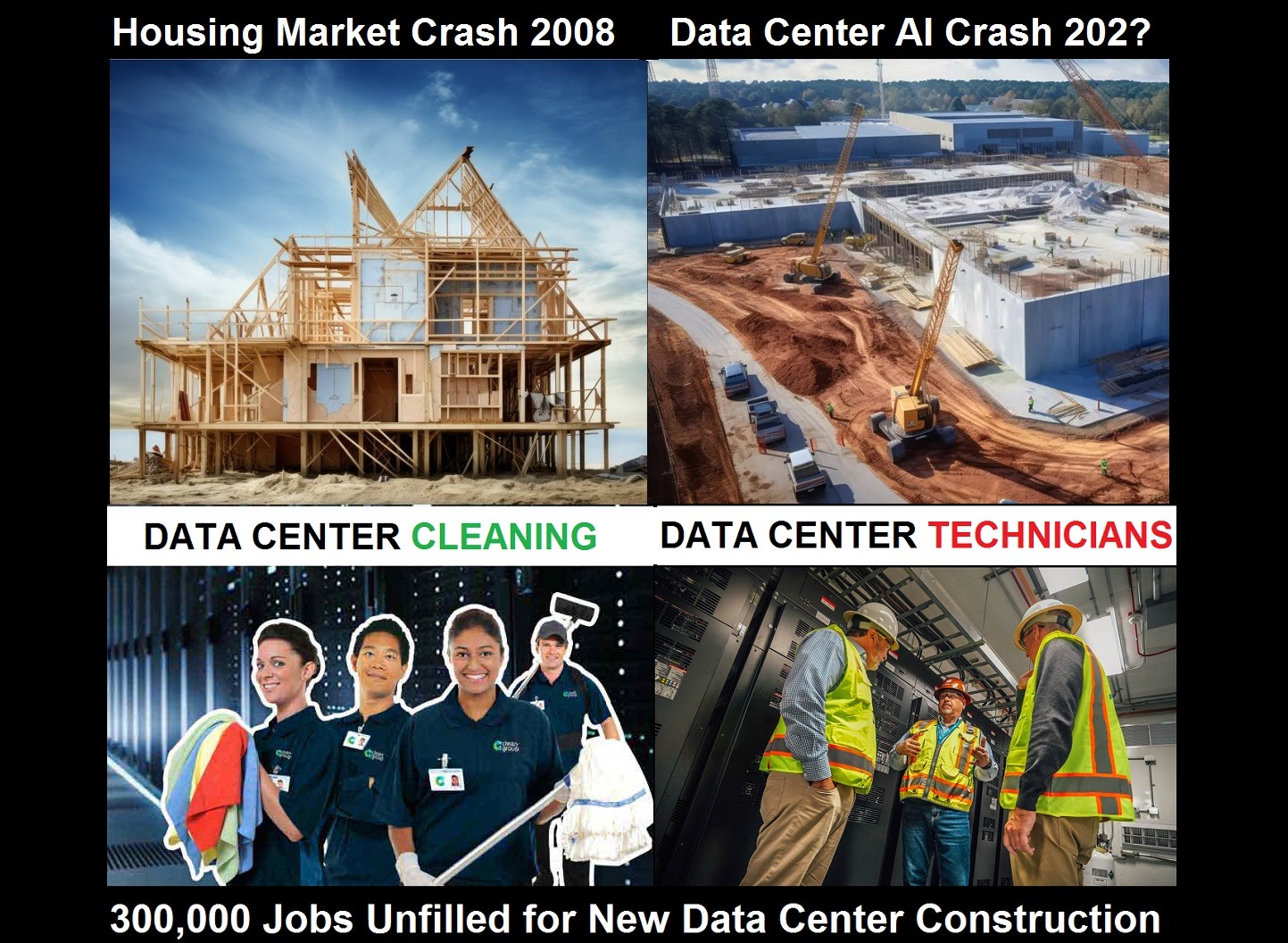
Last month (November, 2025) I reported how many analysts on Wall Street were starting to wake up to the fact that all the money currently being invested into new data centers to power AI is creating many previously unforeseen issues, such as the amount of labor needed to run these huge data centers. See:
The AI Revolution is About to Crash due to a Lack of Human Labor
With many of the Big Tech companies such as Meta now taking on debt to build these huge data centers, others are beginning to sound the alarm as well.
The Information, a privately funded publication covering Tech that does REAL journalism and does not simply regurgitate the talking points about Tech from the legacy corporate media, this week just added a new reporter to cover the topic of “AI Infrastructure” which covers the “data center boom“:
Welcome to AI Infrastructure, a new newsletter focused on how the data center boom is reshaping the energy sector and turning Silicon Valley into a rising industrial power.
Ann Davis Vaughan has covered the intersection of energy and technology as both an investment analyst and journalist for two decades, including 14 years at The Wall Street Journal. Based in Houston, she has researched electrification and previously evaluated dozens of companies that form the backbone of the economy for Select Equity Group, a multibillion-dollar investment firm.
She and the rest of our infrastructure team at The Information bring you exclusive news and analysis on the biggest infrastructure buildout in generations.
Her first article this week was:
The ‘Bragawatt’ Data Center Era Brings Reality Checks—and Energy Breakthroughs
While she does see some potential future benefits to all these investments into new data centers with new energy technologies being developed, she also gives an honest look at where we are today, as opposed to what is hyped in the mass media.
Some excerpts:
The gigawatts of electricity needed for the most ambitious AI data centers aren’t coming online nearly as fast or as easily as the announcements about them did.
Breathless chatter about the AI race makes it seem like the roughly 1 trillion dollars per year that McKinsey estimates will be spent on the infrastructure buildout between now and 2030 is already producing fully electrified AI cities on a hill, one after another.
I’ve been traveling the country to see the steel and concrete rising (and, when I can get inside, the racks rolling in), and it may surprise you how many of the multigigawatt sites you hear about won’t hit full power capacity for years.
Despite public boasts by Elon Musk and other AI leaders about electrified clusters of hundreds of thousands of chips, and announcements of sites so big that people in the data center industry started to joke about “bragawatts,” we’re just barely starting to consolidate one or more gigawatts of data center capacity on a single campus to prove that denser clusters will produce better AI.
Unless dreams quickly come true for nuclear fusion or AI servers in space, it doesn’t look likely that OpenAI CEO Sam Altman can get his hoped-for 250 GW of capacity by 2033, or that xAI founder Elon Musk can soon get to his stated goal of a terawatt (1,000 GW)—equivalent to all of the U.S. electricity produced today—by some unknown date.
For instance, Crusoe, a developer of OpenAI facilities in Abilene, Texas, just announced it had “topped off” the eighth building there, though that merely refers to the erection of the eighth structural frame.
There’s much more to come before chips are installed and all systems are go to achieve 1.2 GW of capacity, expected by mid-2026.
In January, Oracle CEO Larry Ellison said the Abilene site could grow to as many as 20 buildings, but the Texas grid operator can only supply power for eight buildings until new transmission lines can be built, sometime in the next several years, people involved in the projects say.
There are many other infrastructure setbacks and pivots for high-profile U.S. data centers you haven’t read about (a power transformer from China had to be rebuilt, a fiber installation flooded a nearby aquifer, a gas pipeline was maxed out), and some you likely have, such as CoreWeave’s troubled Texas project with Core Scientific.
In Pennsylvania, where a bipartisan state government and energy CEOs are working to usher in a golden age of gas-fired AI, the regional grid regulator recently failed to approve even one of 12 proposals to address electricity demand growth. That has left the busiest computing region in the country, also home to Data Center Alley in Northern Virginia, in limbo.
As Microsoft, Amazon and Meta become the single largest electricity customers in states where they’re developing facilities, they’ve faced an increasing public backlash that could shape next year’s midterm elections.
Just two projects in Wisconsin from Microsoft and OpenAI could require the doubling of available capacity at Wisconsin’s main utility, We Energies, to about 11 GW from 5.3 GW by decade’s end, if they grow as big as the companies envision, according to many people involved in the power planning.
Full article. (Subscription needed.)
Here is another article published today on Market Watch about another analyst who is sounding the alarm about data center investments.
This famed short seller explains why he’s doubling down on his bet against data centers
Jim Chanos says the money will come from what the chips produce, not where they reside
Excerpts:
Investors continue to push doubts to the surface over AI bets paying off into year-end.
Among those with strong views on that theme is prominent investment manager Jim Chanos, best known for past short selling bets on Enron and Tesla.
In a podcast interview with Monetary Matters with Jack Farley, Chanos discussed why he thinks dot-com bust 2.0 could be coming as he explained one bearish bet he’s doubling down on.
The investor placed a big short bet on legacy data centers in 2022, describing the old cloud data center business as “crummy,” with a “very low return on capital business, highly capital intensive.”
Chanos said he’s even less convinced on the newest version of data centers — those that host GPUs, or rent out computing power to AI companies.
“It’s basically a commodity business, particularly as everybody’s building them. And our view to clients has been the magic and the money is going to come from what the chips produce ultimately, not where they reside,” he said.
The overriding AI bet is the technology will hit an inflection point in 2027 or 2028 and profits will flow.
Oracle and Amazon have shown an inability thus far to monetize those big investments in AI, equipment, hardware and locations, and that’s one reason he’s short on Oracle.
Chanos said the data-center world is going to shrink as just a handful will be needed and makes the scenario look “a lot like 1999 and 2000.”
He warns that a credit crunch or pullback in sentiment such as seen the early 2000s would see a lot of that spending by those companies drop fairly fast.
“The risk levels for all these companies are much higher than they were five or 10 years ago,” he said.
And here is another one published on Market Watch yesterday warning about the AI bubble for 2026:
The AI boom will turn to bust in 2026, says this forecaster
Excerpts:
High valuations leave stocks vulnerable to a big tech sell-off, according to BCA Research
The final full week of trading in 2025 is upon us. And as attention increasingly turns to next year it’s fair to say that most analysts’ base cases for equities are pretty bullish, with a median prediction of 7,500 for the S&P 500 by the end of 2026, according to MarketWatch calculations.
But not all observers are so chipper. Indeed, the headline of the latest note from the editorial board at BCA Research, led by chief global strategist Peter Berezin, encapsulates their caution: “Return of Nasdog”.
In other words, it’s the big technology companies of the Nasdaq that will prove a particular drag on the stock market in 2026.
“Given that AI assets typically depreciate at a rate of around 20% per year, this implied that the hyperscalers were facing an annual depreciation expense of $400 billion – more than their combined profits in 2025,” says BCA.
The assumption that AI would significantly boost tech companies’ profits started to look very shaky at the start of 2026, as AI adoption rates moderated.
Big Tech is Now Practically Running the Federal Government in the Trump Administration
Trump recently signed an executive order trying to override any States who develop policy for AI by trying to establish federal standards which will cater to Big Tech interests, which is probably how they are hedging their bets on what is going to happen with the stock market and the collapse of the AI bubble in 2026.
Yesterday it was announced that the Trump Administration is building a “Tech Force” to invest in AI for the U.S. Government. This force will be entirely run by Big Tech themselves.
This appears to be their blueprint for 2026, so they can keep inflating the AI bubble regardless of what happens in the “private” sector.
US government launches ‘Tech Force’ to hire AI talent
The US government is launching an early career hiring and talent development program to bring more technology and artificial intelligence employees to the public sector, as part of the Trump administration’s efforts to modernize government systems and stay ahead in the global tech race.
The launch of the “US Tech Force” is designed to address a technical and early career talent gap across the government, according to Scott Kupor, the director of the Office of Personnel Management which is spearheading the program. The effort comes amid a broader war for AI talent, with tech companies offering sizable salaries and other perks to attract top engineers and researchers.
OPM plans to hire an initial cohort of 1,000 early career software engineers, data scientists, project managers and AI experts to be placed across government agencies for the two-year program. It will also partner with tech companies to recommend early career managers to take a leave of absence from their private-sector roles to join the Tech Force.
“If you’re thinking about, long term, a career in technology, there is no bigger and more complex set of problems than we face in the federal government,” Kupor said in a call with reporters ahead of the program’s announcement Monday.
The Trump administration has sought to implement AI to modernize and make more efficient systems across the federal government.
Members of the Tech Force are expected to work on projects such as incorporating advanced AI into drones and other weapons at the Department of Defense, building out the Trump Accounts platform at the Internal Revenue Service, and using AI to improve intelligence at the State Department, among other initiatives, according to Kupor.
OPM plans to bring in Silicon Valley CEOs and other executives for speaker events. It will also partner with around 25 tech companies to provide mentorship and career planning advice to members of the cohort. Microsoft, Adobe, Amazon, Meta and xAI are among the companies that have signed on as partners of the program.
The program will conclude with a job fair, where program members will have access to both public- and private-sector opportunities. Salaries for members of the Tech Force are expected to range from approximately $130,000 to $195,000.
What this spending by the U.S. Government proves, of course, is that there is a major shortage of HUMAN LABOR in Tech, and the top talent is all being hired by Big Tech to build out their AI models. None of these younger tech workers would want to work for the U.S. Government when they can go work for Google or Meta at a very high starting salary.
This allows the U.S. Government to entice more AI workers, but at what expense? There already exists a huge labor shortage in non-AI tech jobs, like all the legacy computer systems that still run the U.S. Government, and things like Air Traffic Control that desperately needs more workers and better computer systems.
There is also a huge shortage of tech workers in cyber security, which is why we are reading of major hacks into both government and private sector computer systems, including the Cloud servers in data centers.
At the same time, China is developing all of the same AI systems that the U.S. is with no shortage of human labor, and at a fraction of the cost.
They are also starting to dominate the supply chains, such as the rich minerals coming out of Africa, as I noted in the beginning of this article about China “quietly” destroying the U.S. dollar.
It is sad to be so negative about the outlook for the U.S. in 2026, but it is better to know the truth than follow the AI hype that many are now beginning to realize is a huge danger sign, but they are still in the minority when it comes to investing so the tech bubble continues to inflate.
Then of course there is the potential meltdown in cryptocurrency as well. As of today when I am writing this, Bitcoin is still well below the $90,000 price, when all the crypto enthusiasts have been predicting that we would end 2025 with Bitcoin over $250,000.
The bubble is going to burst at some point, and it could be in 2026.
See Also:
Is the Crypto Ponzi Scheme Finally Coming to an End?
Are Cryptocurrencies Dying? The Big Tech Collapse Draws Closer with a “Crypto Winter” Approaching
Comment on this article at HealthImpactNews.com.
This article was written by Human Superior Intelligence (HSI)


See Also:
Understand the Times We are Currently Living Through
New FREE eBook! Restoring the Foundation of New Testament Faith in Jesus Christ – by Brian Shilhavy

What Kind of Person did Jesus Say was True with no Injustice in Them?

KABBALAH: The Anti-Christ Religion of Satan that Controls the World Today

Christian Teaching on Sex and Marriage vs. The Actual Biblical Teaching

Exposing the Christian Zionism Cult

The Bewitching of America with the Evil Eye and the Mark of the Beast

Jesus Christ’s Opposition to the Jewish State: Lessons for Today

Identifying the Luciferian Globalists Implementing the New World Order – Who are the “Jews”?

The Brain Myth: Your Intellect and Thoughts Originate in Your Heart, Not Your Brain

What is the Condition of Your Heart? The Superiority of the Human Heart over the Human Brain

The Seal and Mark of God is Far More Important than the “Mark of the Beast” – Are You Prepared for What’s Coming?

The Satanic Roots to Modern Medicine – The Image of the Beast?

Medicine: Idolatry in the Twenty First Century – 10-Year-Old Article More Relevant Today than the Day it was Written


Having problems receiving our emails? See:

How to Beat Internet Censorship and Create Your Own Newsfeed
We Are Now on Telegram. Video channels at Bitchute, and Odysee.
If our website is seized and shut down, find us on Telegram, as well as Bitchute and Odysee for further instructions about where to find us.
If you use the TOR Onion browser, here are the links and corresponding URLs to use in the TOR browser to find us on the Dark Web: Health Impact News, Vaccine Impact, Medical Kidnap, Created4Health, CoconutOil.com.