
 [1]
[1]
by Brian Shilhavy
Health Impact News
I have recently incorporated fresh sea moss (also sometimes referred to as “seaweed” or “macroalgae”) gels into my diet which has had a very positive impact on health.
The peer-reviewed medical literature is full of studies conducted on sea moss and the gelatin formed from it, and its recognized health benefits.
One study published last year [2] (2025) identified the polysaccharides in sea moss as modulating gut microbiota.
Seaweed polysaccharides and their potential health effects via gut microbiota modulation
Abstract
Macroalgae, commonly known as seaweeds, are a valuable source of polysaccharides known to modulate gut microbiota. In this work, the impact of polysaccharide structural features on gut microbiota was explored. The low molecular weight algae polysaccharides showed better degradation by gut bacteria. Moreover, the content of sulfate and carboxylic groups seem to promote high fermentation, triggering an increase in gut microbiota health. The effect of ramification degree of algae polysaccharides on fermentability is still unclear. Agar polysaccharides with low molecular weight and a higher degree of sulfation have been shown to produce higher amounts of SCFA, and decrease in Firmicutes/Bacteroidetes ratio. An increase of sulfation degree of porphyran showed to increase the total SCFA production and a decrease on the ratio of butyric to propionic acid. Carrageenan’s molecular weight does not seem to affect SCFA production, and the effect of sulfation degree is not clear. The consumption of these polysaccharides was shown to decrease the Firmicutes/Bacteroidetes ratio. Fucoidans of low molecular weight seem to promote a lower Firmicutes/Bacteroidetes ratio. Alginate consumption both of high and low molecular weight has been shown to increase Bacteroidetes. Low molecular weight laminarans are highly fermented and significantly increase the production of SCFA. Ulvan and sulfated rhamnan polysaccharides have been shown to increase the production of SCFA, although microbiota modulation data are still undisclosed. Overall, seaweed polysaccharides have shown several health benefits, which have been related with gut microbiota modulation.
Source [2].
Another study published last year [3] found that bioactive compounds derived from brown, red and green seaweeds showed promising results in cognitive decline prevention in Alzheimer’s patients. See:
Therapeutic Potentials of the Seaweed-Derived Compounds for Alzheimer’s Disease [3]
A previously published study by Korean researchers [4] found that the bioactive compounds in marine algae had many benefits for healthy skin.
Beneficial Effects of Marine Algae-Derived Carbohydrates for Skin Health
Abstract
Marine algae are considered to be an abundant sources of bioactive compounds with cosmeceutical potential. Recently, a great deal of interest has focused on the health-promoting effects of marine bioactive compounds. Carbohydrates are the major and abundant constituent of marine algae and have been utilized in cosmetic formulations, as moisturizing and thickening agents for example. In addition, marine carbohydrates have been suggested as promising bioactive biomaterials for their various properties beneficial to skin, including antioxidant, anti-melanogenic and skin anti-aging properties. Therefore, marine algae carbohydrates have potential skin health benefits for value-added cosmeceutical applications. The present review focuses on the various biological capacities and potential skin health benefits of bioactive marine carbohydrates. (Full study [4].)
Another study published a few years ago [5] showed promising results of certain components of marine algae in type 2 diabetes. See:
Padina tenuis (marine alga) attenuates oxidative stress and streptozotocin-induced type 2 diabetic indices in Wistar albino rats [5]
In 2022 Chinese researchers looked at seaweed-derived bioactive compounds in treating colorectal cancer. See:
Anti-colorectal cancer effects of seaweed-derived bioactive compounds [6]
This is just a sampling of the research published on the health benefits of sea moss, and as you can see, the research is mostly on certain components within sea moss that can be extracted and made into medicines, because sea moss itself is a natural product that cannot be patented.
You are better off with the REAL THING, if it is fresh and not mass produced like the processed forms with their added preservatives and chemicals that go along with most food that is mass-produced for the mass market.
The consumption of sea moss can be dated back to the fourth-century in Japan and the sixth-century in China.
Before I explain the source where I found my fresh sea moss gel at, and that my online store, Healthy Traditions, is now also selling [1], let’s review the history of “gelatin”.
Colored and Flavored Gelatins Used to Only be Consumed by the Wealthy Class

Image source [7].
Gelatin in most Western cultures has historically been mostly made from the bones of cattle, and once used to be considered a health food and only consumed by the wealthy class.
It required human labor to make the gelatin before mass production came in during the Industrial Revolution and turned it into a mass-produced commodity that today may not only not be very healthy, but actually toxic, such as jellos and jellies sold today in the mass market.
Dylan Miettinen, writing for Marketplace [8], recounts the history of “Jell-O”:
How the class history of Jell-O came full circle
Before the likes of Jell-O brand gelatin came … well … just gelatin. One of the first recorded recipes for aspic, gelatin’s savory cousin, appeared in the late 1300s in the French cookbook “Le Viandier.”
Gelatin is derived from the structural protein collagen, which is found in the skins and bones of animals like pigs and cows. Those animal parts are boiled down until collagen can be extracted and formed into a gelatinous concoction. This process is incredibly time-intensive, though — it could take two days of work or longer to produce calf’s feet jelly, as it was called.
Because it took so long to prepare, gelatin was a dish reserved for the elites. And it would often be highly ornamental.
“That was a statement, just the way, if you bought a Porsche or a BMW today, or a Rolex watch, people would know you were rich,” explained Carolyn Wyman, the author of “Jell-O: A Biography.”
But then came the Industrial Revolution, and with it, more industrialized foods. Like instant gelatin.
Full article [8].
Mark Hay, writing for Atlas Obscura [7], goes into even more details:
Before Jell-O, Colorful Gelatin Desserts Were Haute Cuisine
Celebrity chefs served molded jelly dishes to monarchs and royalty.
Excerpts:
MARIE-ANTOINE CARÊME MADE HIS NAME cooking for some of the greatest figures in France at the dawn of the 19th century, including Napoleon Bonaparte.
He was arguably the world’s first celebrity chef, and later served Czar Alexander of Russia and King George IV of England, evangelizing the elaborate and expensive haute cuisine he’d helped pioneer. He even invented some of France’s best-known desserts, such as croquembouche and mille-feuille.
He was also a fan of gelatin. As food historian Christina Ward has noted, he was especially renowned for the massive, architecturally inspired molded gelatin dishes that often served as showstopper edible centerpieces for his feasts. In modern terms, this would be like a master chef placing towering Jell-O concoctions at a royal wedding or the French Laundry.
That may surprise American readers, since their gelatin desserts are now decidedly lowbrow. Gelatin is the cheap, boring convenience food Baby Boomers stuffed down their kids’ maws and dieters turned to in the ‘80s and ‘90s.
Mid-20th century dishes such as avocado and grapefruit encased in lime Jell-O and topped with mayo are widely viewed as the nadir of American cooking—symbols of the era when everything got the gelatin treatment and the borders between salad and dessert courses blurred.
Gelatin is, to many today, so childish or distasteful that a slew of articles reported, several years ago, on a free fall of sales of Jell-O and similar brands [9].
But Carême’s love for gelatin and use of it in high-end cuisine was hardly a culinary aberration. From the early Renaissance through the early-20th century, gelatin “salads” and desserts were prestigious dishes and the provenance of master chefs.
Gelatin primarily rose to become a status symbol, though, because of the wealth implied by the time and effort required to make it regularly. Rounds of boiling and straining out impurities took more than a day to complete.
The 14th-century French chef Guillaume Tirel, a.k.a. Taillevent, explained in his Le Viandier that,
“He who would make a gelatin is not allowed to sleep.”
Gelatin wasn’t expensive or hard to make on its own, argues medieval food historian Ken Albala. Russian families of all classes, for example, have long prepared kholodets, savory meat cuts suspended in gelatin, as a winter holiday treat.
But serving gelatins, especially elaborate ones, often, rather than as a special holiday dish, was a clear sign of wealth. It showed you could hire a dedicated cooking staff to go through the arduous and (frankly) stinky process of making it.
Full article [7].
Sea Moss Gels Made Fresh by Hand and Not Mass Produced
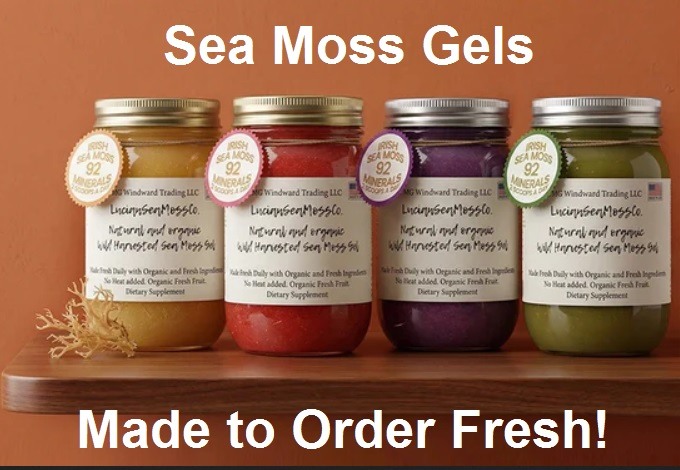
For the past several weeks I have been consuming fresh sea moss gels on a daily basis, sourced from what I believe is the best sea moss producer in the U.S.
This supplier gets their sea moss from the shores of St. Lucia, and each order is made fresh with only the highest ingredients available added to each gel. The fruit gels are made from organic fresh fruits, for example.
It would be like stopping into a “juice bar” or “smoothie bar” and having them make it fresh for you on the spot, except you don’t have to actually go anywhere because it will be shipped fresh to your door.
I have personally met and talked with the owner, Rachel Grossi, several times over the past several weeks, and we both share the same passion in bringing products to market that are produced by small-scale producers, and NOT mass produced.
To “scale” products like this, means to “scale incrementally”, a term I have used over the years to describe to companies and buyers who have wanted to purchase large quantities of our Healthy Traditions products.
For companies like us, we CAN scale with human labor, as I have proven that for over 20 years by selling our famous Gold Label Virgin Coconut Oil [10] at very large quantities by training more people to continue producing in small batches, where the quality can be carefully controlled. It just takes longer.
This kind of scaling provides two distinct benefits:
First, it provides more jobs instead of investing in technology.
Second, it produces a much higher quality product that technology and machines cannot produce.
This principle of “incremental scaling” is also practiced by many of our other producers, including our Mexican corn [11], which can be traced all the way back to the family and community farms it was grown on.
When Rachel founded her Sea Moss company, she also practiced this principle.
Here is some more information on Rachel Grossi:
Rachel is a lover of all things St. Lucia, and has been conducting business there for many years. While on a trip, Rachel shared that she suffered from Fibromyalgia which was being managed by many medications that weren’t very effective, and she had many instances of flare-ups that severely impacted her life.
She was introduced to a local sea moss farmer so that she could learn about sea moss and see if perhaps it could help make her fibromyalgia more manageable.
After a few short weeks, Rachel was able to stop taking all medications. She stopped having fibromyalgia flare-ups and was able to become more active, become pain free, and jump full force back into life.
Rachel has spent vast amounts of time and money perfecting her patented recipe, ensuring that only the most pure and highest quality ingredients are used while also understanding the chemistry of sea moss itself.
Healthy Traditions Begins New Market for Small-Scale Producers!
 [12]
[12]
This collaboration with Rachel and her Sea Moss products starts a new program that Healthy Traditions is now beginning.
Having been in business since the dot-com market collapse around 2001-2002 all the way through today, we have faced enormous market pressures for the past 25 years.
In the early days, we were one of the first companies in the U.S. to actually start selling food over the Internet. Facebook and Google were not even around back then as the powerhouse Big Tech companies they are today, and Amazon.com was still selling mostly books.
We utilized the power of the Internet to educate consumers on the truth regarding coconut oil and saturated fats, and in doing so helped change the buying habits of enough Americans to create a market for our Virgin Coconut Oil, which before had never even been available in the U.S., due to politics and lies by the U.S. Government agencies that are setup to protect Big Business, and not American consumers.
As a result, today one can walk into almost any grocery store in the U.S. purchase coconut oil, which is a great benefit to the American consumer, even if they are all machine-made and mass produced. Even refined coconut oils are far better than the alternatives, which are mostly very unhealthy forms of polyunsaturated oils that are toxic, such as corn, soybean, and Canola oils.
But eventually Silicon Valley and Wall Street caught up and started controlling the flow of information on the Internet, and today all the larger corporations such as Amazon.com and Walmart and many others control most of the searches on the Internet, making it extremely difficult to find such high quality products like the ones we sell.
Therefore, we are starting a new program to link together small-scale producers where we can all increase our product offerings by working together, and these amazing Sea Moss products are the first products in this new program that we are still creating.
For now, it is by invitation only, but soon we will be soliciting inquires from other businesses who share our values, and who are already trying to sell on the Internet.
In phase 2, we will help local producers who primarily sell in their local communities such as in farmer’s markets, to get their products online and also be able to expand their market.
There are other exciting plans for the future of Healthy Traditions, so stay subscribed to my publications on Health Impact News, as well as our daily sales emails [13] sent to all of our customers at Healthy Traditions.
In the meantime, check out some of these AMAZING fresh Sea Moss products [1]!
Being a senior citizen now, these gels have become a welcome part of my daily routine and given me better energy and better bowel movements since I started consuming them.
Comment on this article at HealthImpactNews.com [14].
This article was written by Human Superior Intelligence (HSI) [15]
[15]
 [16]
[16]
 [17]
[17]
See Also:
Understand the Times We are Currently Living Through
The Brain Myth: Your Intellect and Thoughts Originate in Your Heart, Not Your Brain [18]
 [18]
[18]
Is God’s Patience About to Run Out on the United States? [19]
 [19]
[19]
Second Edition of eBook Released: The Concept of the American Christian Family is a Myth and is NOT Found Anywhere in the Bible – by Brian Shilhavy [20]
 [20]
[20]
FREE eBook! Restoring the Foundation of New Testament Faith in Jesus Christ – by Brian Shilhavy [21]
 [21]
[21]
KABBALAH: The Anti-Christ Religion of Satan that Controls the World Today [22]
 [22]
[22]
Exposing the Christian Zionism Cult [23]
 [23]
[23]
The Bewitching of America with the Evil Eye and the Mark of the Beast [24]
 [24]
[24]
Jesus Christ’s Opposition to the Jewish State: Lessons for Today [25]
 [25]
[25]
Identifying the Luciferian Globalists Implementing the New World Order – Who are the “Jews”? [26]
 [26]
[26]
The Seal and Mark of God is Far More Important than the “Mark of the Beast” – Are You Prepared for What’s Coming? [27]
 [27]
[27]
The Satanic Roots to Modern Medicine – The Image of the Beast? [28]
 [28]
[28]
Medicine: Idolatry in the Twenty First Century – 10-Year-Old Article More Relevant Today than the Day it was Written [29]
 [29]
[29]
 [30]
[30]
Having problems receiving our emails? See:
 [31]
[31]
How to Beat Internet Censorship and Create Your Own Newsfeed [31]
We Are Now on Telegram [32]. Video channels at Bitchute [33], and Odysee [34].
If our website is seized and shut down, find us on Telegram [32], as well as Bitchute [33] and Odysee [34] for further instructions about where to find us.
If you use the TOR Onion browser [35], here are the links and corresponding URLs to use in the TOR browser [35] to find us on the Dark Web: Health Impact News [36], Vaccine Impact [37], Medical Kidnap [38], Created4Health [39], CoconutOil.com [40].