

by Brian Shilhavy
Health Impact News
With new IPOs coming up for Musk’s SpaceX and for Sam Altman’s OpenAI, Wall Street, which is increasingly becoming less tech savvy and just investing in hype, is going to take the next step in bankrupting America.
Haven’t people learned from Elon Musk’s constant lies for the past two decades?
Where are his fully autonomous driverless taxis? Where are the $35K human robots that he promised would be in everyone’s homes by now?
It’s all BS! But people keep feeding it, too scared to be left behind.
Now the biggest IPO in the nation’s history is set to happen next week for SpaceX.
Is SpaceX rolling in the cash with record sales? Nope. It is actually losing money.
So why will Wall Street groupies invest?
Because Musk promised them there would be floating data centers in space to fuel the expansion of AI, in the future.
Everyone and anyone who is investing in Musk is continuing to invest in the future, for a version of science fiction which will never happen.
And because Musk is also behind removing regulations to protect American’s retirement accounts from such risky investments, within the next few weeks a majority of Americans’ retirement accounts may be left holding the bill for these mammoth Big Tech IPOs, whether they want to or not.
They say Rome did not fall in one day, but America just might.
From The Information [2]:
Excerpts:
Elon Musk and Sam Altman don’t often see eye to eye, as they made clear in their recent legal dispute. But when it comes to making outlandish projections about future growth, the two men seem to share a common philosophy.
As we reported earlier on Thursday, SpaceX’s lead bank on its upcoming IPO, Goldman Sachs, has told investors it expects SpaceX’s revenue to hit $474 billion by 2030, from $18.7 billion last year.
That’s even more ambitious than OpenAI’s projection—which we reported in February—that its revenue will grow to $284 billion by 2030 from $13 billion in 2025.
Both companies also expect to burn massive amounts of cash in the same period, although SpaceX outdoes OpenAI on that count as well.
Neither of these sets of projections is particularly believable, of course. Sure, OpenAI might become a major player in digital advertising—a key part of its growth story—but it has presented little that would support the long-range forecasts it has put forward. SpaceX’s projections are no better.
Our story today, by my colleague Cory Weinberg, says two-thirds of the projected 2030 revenue would come from AI, which implies SpaceX thinks it will be bigger than OpenAI by then.
And yet right now, SpaceX’s AI unit is nowhere. Its revenue last year of $3.2 billion was mostly from ads generated by X, the business formerly known as Twitter, which doesn’t count as AI (the discourse on X could be better described as a lack of intelligence, artificial or otherwise).
OpenAI, for all its travails, at least has real AI revenue, amounting to $5.7 billion in the first quarter. Moreover, constant employee turnover has turned xAI upside down, and the status of its model development is unclear. Musk has leased out much of its computing infrastructure to rivals such as Anthropic.
We get that the credibility of these projections isn’t important to the Musk fans who are likely to support SpaceX’s stock offering, which is expected to go to market next week.
But it is worth noting Musk’s dismal history of meeting projections.
In 2022, for instance, he told investors he expected to lift Twitter’s revenue to $26.4 billion in 2028, up from $5 billion in 2021, according to this New York Times account [3].
How’s he doing?
X’s ad business has dropped by half. (SpaceX’s IPO prospectus shows the AI segment’s revenue was $2.6 billion in 2024, “substantially all” of it from X.)
Musk combined X into xAI, and the resulting AI unit is also generating revenue from selling subscriptions to its Grok AI chatbot and renting out computing capacity.
Those X numbers are no longer relevant, but they are a reminder of the value of long-term revenue projections.
Elon Musk’s $1.75 trillion SpaceX valuation leaves virtually zero room for error
From MarketWatch [4]:
Excerpts:
Want to buy SpaceX stock? History suggests it will struggle to reward IPO investors.
SpaceX’s sky-high market valuation — $1.75 trillion at a proposed $135-a-share price — makes it extremely unlikely its stock will be able to even keep up with the S&P 500 in coming years.
Here’s why: Consider the company’s price-to-sales ratio (PSR) at its offering price. This ratio is highly useful when valuing IPOs. Other valuation ratios aren’t particularly insightful since many IPOs come to market before booking any earnings.
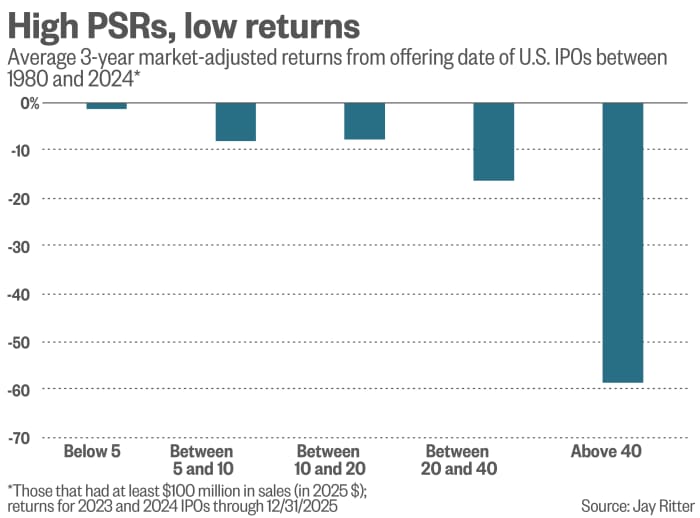
At the $135-per-share price that SpaceX is targeting for its IPO, its PSR will be more than 90-to-1 — one of the highest in U.S. market history. Even IPOs that came to market with PSRs half as high have proceeded to underperform the market over the three years after going public.
This is illustrated in the chart above, which plots data from Jay Ritter, a University of Florida finance professor who has compiled the premier academic database of U.S. IPOs. There is a strong inverse correlation between an IPO’s PSR and its subsequent three-year return. Those whose PSRs were above 40 when coming to market lagged the market by 58.5% over the three years after coming to market. (A full description of Ritter’s calculations are available here.)
To put SpaceX’s PSR in context, consider that the S&P 500’s comparable ratio is 3.7. Of course, fast-growing stocks typically trade at higher PSRs, so the S&P 500 may not be the most appropriate comparison. But even the growth-oriented Nasdaq 100 indexhas a current PSR of just 6.1, and none of that index’s constituent stocks has a PSR as high as what SpaceX’s will be at its expected initial offering price.
A good story — but maybe not a good stock
Given these numbers, it’s safe to say that SpaceX’s IPO is not being sold as a valuation play.
SpaceX and Anthropic are about to go public—and your 401(k) may be forced to buy in
From Fortune [5]:
Excerpts:
Two of the most valuable companies in history are about to go public, and because of their sheer size, they may fundamentally alter what sits inside millions of Americans’ retirement accounts.
With SpaceX’s IPO also sparking index providers to change the rules on how stocks are added to major stock market indexes (like Nasdaq or the S&P 500), you may soon feel the effects of the IPO much faster than you would have otherwise.
Index funds are usually the backbone of most 401(k)s, and because they’re obligated to buy whatever is in the index, changing the rules may be the mechanism that forces one’s exposure to a new IPO, such as SpaceX’s, and eventually Anthropic’s.
But simply because SpaceX and Anthropic are so enormous at their debut (SpaceX at $1.77 trillion as of Wednesday and Anthropic expected at nearly $1 trillion), index providers can’t necessarily leave them out.
So they’ve shortened or even eliminated the seasoning period, meaning your 401(K) will reflect their presence in the stock market that much sooner.
Wasted AI budgets at Uber, Microsoft and Nvidia trigger hiring — because human workers are cheaper

From MarketWatch [6]:
Uber blew its entire 2026 AI budget by April. Here’s why replacing workers with bots backfired.
Excerpts:
Corporate executives are realizing that it’s more expensive to replace employees with artificial intelligence, contrary to what was previously believed. That’s good news for the U.S. labor market.
What’s causing this about-face? Blame the tokens. When an employee asks AI for help, the request consumes digital tokens, which are the currency of LLMs and a cost of doing business.
Workers at tech companies in particular have been encouraged to ramp up their token consumption — known as “tokenmaxxing” — by employers conflating AI tools with productivity. It has become somewhat of a status symbol amongst employees to be tokenmaxxing to prove that you’re going above and beyond to meet key performance indicators.
But tokenmaxxing is expensive. For text-based inquiries, the math is simple, with 750 words costing 1,000 tokens. But generating video, images, code and more can cost a lot more — and it’s not until after the task has been carried out that the bill comes due.
These costs have been catching employers off guard, especially with the increased use of agentic AI sucking up tokens. As a result, employers are frequently blowing through their AI budgets, putting them in a situation where it’s no longer clear that using AI is cheaper than hiring people.
For example, Uber Technologies’ operations chief recently raised concerns about the cost of tokenmaxxing, especially because by April, the ride-hailing company had already blown through its entire 2026 AI budget. Microsoft has canceled its Claude Code licenses and asked employees to use its own GitHub Copilot CLI — with many speculating that high costs drove the decision.
A team at Nvidia for months has reported higher costs for AI than humans. Amazon.com axed its internal AI leaderboard. One company even accidentally spent $500 million in a month recently on Claude, according to Axios.
The widespread pullback shows that companies are dissatisfied with the return on investment on AI.
Big Tech companies have poured billions of dollars into building out AI infrastructure over the past few years in hopes that it’s the future.
Enterprises have adopted AI into their workflows to fare better against competitors.
While Big Tech stocks may still be flying high, some companies are realizing they can’t sustain this level of spending on tokens.
Comment on this article at HealthImpactNews.com [7].
This article was written by Human Superior Intelligence (HSI) [8]
[8]
 [9]
[9]
 [10]
[10]
See Also:
Understand the Times We are Currently Living Through
The Brain Myth: Your Intellect and Thoughts Originate in Your Heart, Not Your Brain [11]
 [11]
[11]
Is God’s Patience About to Run Out on the United States? [12]
 [12]
[12]
Second Edition of eBook Released: The Concept of the American Christian Family is a Myth and is NOT Found Anywhere in the Bible – by Brian Shilhavy [13]
 [13]
[13]
FREE eBook! Restoring the Foundation of New Testament Faith in Jesus Christ – by Brian Shilhavy [14]
 [14]
[14]
KABBALAH: The Anti-Christ Religion of Satan that Controls the World Today [15]
 [15]
[15]
Exposing the Christian Zionism Cult [16]
 [16]
[16]
The Bewitching of America with the Evil Eye and the Mark of the Beast [17]
 [17]
[17]
Jesus Christ’s Opposition to the Jewish State: Lessons for Today [18]
 [18]
[18]
Identifying the Luciferian Globalists Implementing the New World Order – Who are the “Jews”? [19]
 [19]
[19]
The Seal and Mark of God is Far More Important than the “Mark of the Beast” – Are You Prepared for What’s Coming? [20]
 [20]
[20]
The Satanic Roots to Modern Medicine – The Image of the Beast? [21]
 [21]
[21]
Medicine: Idolatry in the Twenty First Century – 10-Year-Old Article More Relevant Today than the Day it was Written [22]
 [22]
[22]
 [23]
[23]
Having problems receiving our emails? See:
 [24]
[24]
How to Beat Internet Censorship and Create Your Own Newsfeed [24]
We Are Now on Telegram [25]. Video channels at Bitchute [26], and Odysee [27].
If our website is seized and shut down, find us on Telegram [25], as well as Bitchute [26] and Odysee [27] for further instructions about where to find us.
If you use the TOR Onion browser [28], here are the links and corresponding URLs to use in the TOR browser [28] to find us on the Dark Web: Health Impact News [29], Vaccine Impact [30], Medical Kidnap [31], Created4Health [32], CoconutOil.com [33].